
UCC Article 12: what the 2022 update does and why it matters for Wisconsin
Thirty-six states and the District of Columbia have updated their commercial code so digital assets can be owned, sold and pledged as collateral under clear rules. Wisconsin has not.
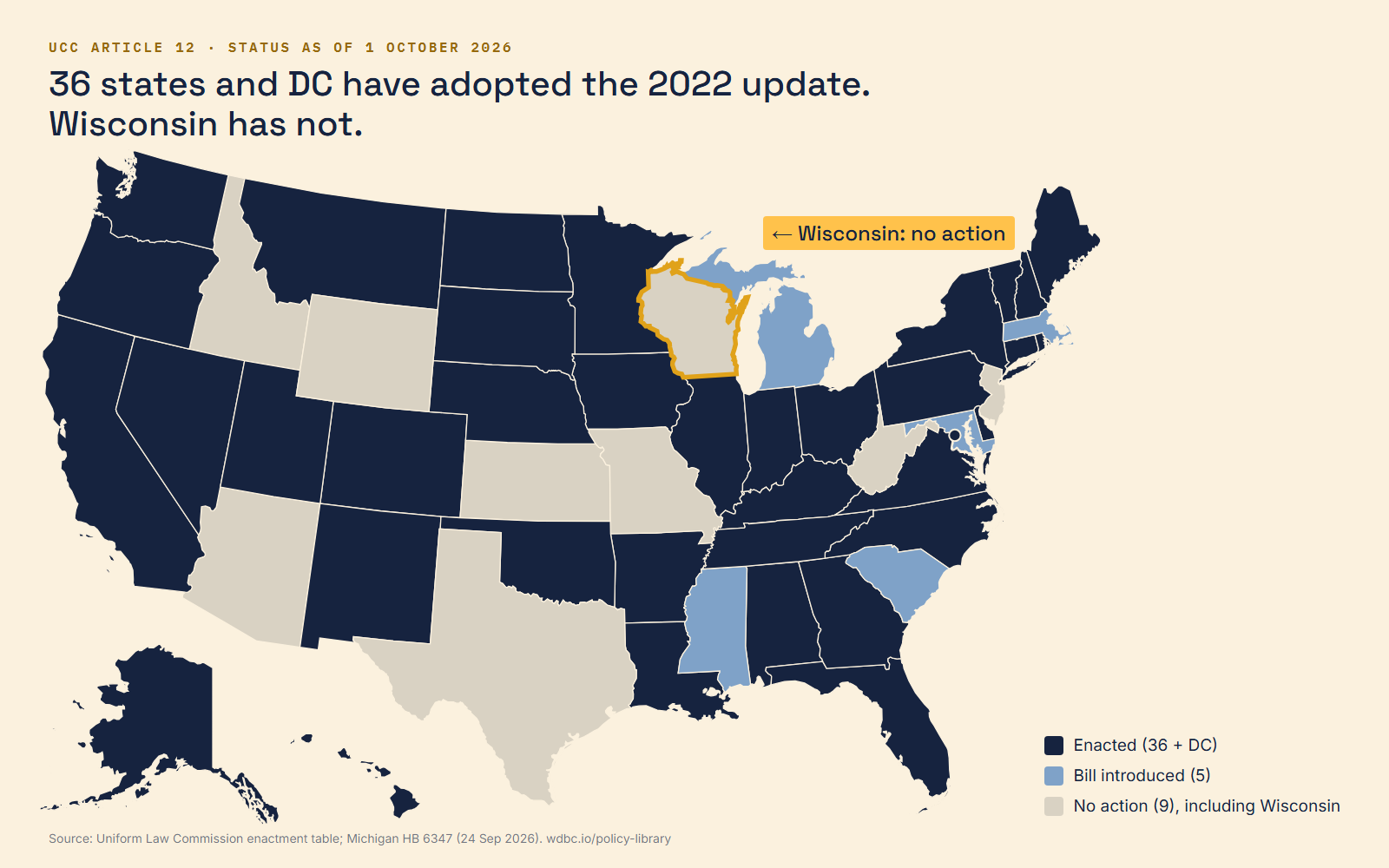
Current as of 1 October 2026
The bottom line
Thirty-six states and the District of Columbia have updated their commercial code so that digital assets can be owned, sold and pledged as collateral under clear rules. Wisconsin has not, and no bill to do it was introduced in the 2025-26 session or the 2023-24 session.
The update is the 2022 amendments to the Uniform Commercial Code, best known for the new Article 12. Illinois, Minnesota and Iowa adopted it in 2024. A bill to adopt it was introduced in Michigan on 24 September 2026.
What the 2022 amendments do
- A recognized asset class. Article 12 creates “controllable electronic records”, a category that covers cryptocurrency, NFTs and assets built on future technologies that work the same way.
- Control works like possession. A person has control when they can use and transfer the asset and can be identified as the holder, for example by a cryptographic key. A lender with control has a perfected security interest that ranks ahead of lenders without it. Today the only route is filing a financing statement, which gives a lender no reliable priority.
- Good-faith buyers get clean title. A buyer who pays value in good faith and takes control takes free of competing property claims, the same way a shop that accepts cash in good faith keeps it.
- Digital rights to payment work like promissory notes. “Controllable accounts” and “controllable payment intangibles” can be transferred and financed with the same certainty as a paper note.
The amendments also update the definition of “money”. Government-issued money can be tangible or electronic, and private cryptocurrencies such as Bitcoin are treated as controllable electronic records, not as money.
Who it helps in Wisconsin
Growth
- Community banks and credit unions that want to lend against digital assets, or hold them for members, with a perfection rule written for the asset.
- Businesses that hold, accept or tokenize assets, and that need financing terms a lender in Chicago or Minneapolis will recognize.
- Wisconsin firms that contract across state lines, since 36 states and DC already apply the same text.
Trust
- Buyers and customers, who get a clear answer to who owns an asset after a transfer.
- Lenders and borrowers, who get predictable priority if a business fails, instead of litigating questions the current code never contemplated.
- The Department of Financial Institutions, which runs the state’s UCC filing office and would administer a written rule rather than case-by-case uncertainty.
Where Wisconsin stands
Wisconsin’s commercial code, chapters 401 to 411 of the statutes, has no Article 12. The word “controllable” does not appear in chapter 401 or chapter 409 (secured transactions), and the “money” definition in s. 401.201 (2) (m) is the pre-2022 text. The only commercial-code bill of the 2025-26 session, 2025 AB 133 and SB 123, dealt with investment securities under Article 8.
The Legislative Council’s staff brief for the Study Committee on Cryptocurrency (SB-2026-03, 11 August 2026) explains the 2022 amendments in detail and lists Wisconsin among the states that have taken no action. The Department of Financial Institutions listed “UCC update for CERs” among the non-staking topics in its 18 August presentation to the committee.
In the region, Illinois (Public Act 103-1036), Minnesota (2024 Laws, chapter 93) and Iowa (2024 Acts, chapter 1023) have enacted the amendments. Michigan HB 6347 is pending in the House Committee on Finance. The Illinois bill passed 57-0 in the Senate and 110-0 in the House. Minnesota’s passed 120-8 and 59-4.
What it is not
- It is not a subsidy and it is not regulation. The UCC is private commercial law: default rules for transactions between parties.
- It does not decide whether any token is a security, and it does not touch staking.
- It does not create or authorize a central bank digital currency. The Uniform Law Commission’s 2023 statement makes the point that legal tender is a federal question and the UCC cannot change it.
The “money” definition is where the debate has been. South Dakota’s governor vetoed the amendments in 2023, arguing that the definition disadvantaged cryptocurrency and eased the way for a CBDC. South Dakota enacted them the following year with language making clear the definition does not create or adopt a CBDC. Tennessee (SB 2219, 2024), Iowa, Indiana, Florida and Utah have each written an express CBDC exclusion into their code. Wisconsin’s own 2023 AB 725 drafted the same kind of exclusion for s. 401.201. A Wisconsin version can carry that language and keep the rest of the uniform text intact.
Why uniform law matters
Drafted jointly by


The UCC is drafted jointly by the Uniform Law Commission and the American Law Institute, two nonpartisan bodies, and works because nearly every state enacts the same text. A loan secured by digital assets, or a sale between a Wisconsin buyer and an out-of-state seller, should not turn on which state’s courts hear the dispute. The ULC publishes an enactment kit, the final act with official comments and a summary for anyone who wants the detail.
How it connects to the 2027 agenda
Any Wisconsin framework for state-supervised payment stablecoin issuers under the federal GENIUS Act will rely on clear rules for custody, transfer and collateral. Article 12 supplies the commercial-law floor beneath that work. More on that lane is on our digital assets page.
What WDBC is doing
We are publishing this analysis and discussing it with banks, credit unions and practitioners. The Study Committee on Cryptocurrency’s charge allows it to “review other current and potential uses of cryptocurrency and recommend legislation regarding the use and development of cryptocurrency that encourages innovation and adequately protects the public.” Follow the committee’s public record on our 2026 interim committees page.
Sources
- Wisconsin Legislative Council, Staff Brief SB-2026-03, Study Committee on Cryptocurrency (11 August 2026), pp. 13-15
- Department of Financial Institutions, presentation to the Study Committee (18 August 2026)
- Wis. Stat. ch. 401 and ch. 409
- 2023 Wisconsin AB 725
- Uniform Law Commission, 2022 Amendments to the UCC: enactment status, enactment kit and final act
- Uniform Law Commission, Statement on Central Bank Digital Currency and the 2022 UCC Amendments (12 April 2023)
- South Dakota Governor, veto of HB 1193 (9 March 2023)
- Tennessee SB 2219 (2024)
- Illinois SB 3696, Public Act 103-1036; Minnesota HF 3868; Iowa 2024 Acts ch. 1023; Michigan HB 6347
This entry reports and explains public policy; it is not legal advice. Corrections are welcome at team@wdbc.io.

Analysis like this is what membership funds
Every library entry is researched from the statute books and the bill record, and dated so you know how current it is. Members get the tracker, Intelligence Briefings and early notice when a new entry is published.