
National model legislation and where Wisconsin stands
The Digital Chamber’s State Network has published six model state bills. Wisconsin has law close to one of them, narrower law touching two more, and no law on the other three.
Current as of 1 October 2026
The bottom line
The six models cover stablecoins, money transmission, a digital asset reserve, an emerging-technology task force, digital identity and AI-generated content. Every related 2025–26 Wisconsin bill that had not passed by 23 March 2026 has expired, so any of these ideas would start fresh when the 2027–28 Legislature convenes in January. WDBC has taken no position on any of the six models. This entry explains what each would do and what Wisconsin law says today.
Where the models come from
The Digital Chamber’s State Network, an initiative of The Digital Chamber, released its Model Legislation Library in August and September 2026. Each model is a bill template with blanks for agency names, dates and dollar thresholds. Five come with drafter guides that explain the choices and cite other states’ laws. TDC describes the library as developed with state policymakers, industry leaders and subject matter experts. The full library is at state.digitalchamber.org/model-legislation.
Logos identify the publishers of source material. They do not imply endorsement of WDBC or its analysis.
The model bills
Read the source documents
Each opens the published PDF from The Digital Chamber State Network.
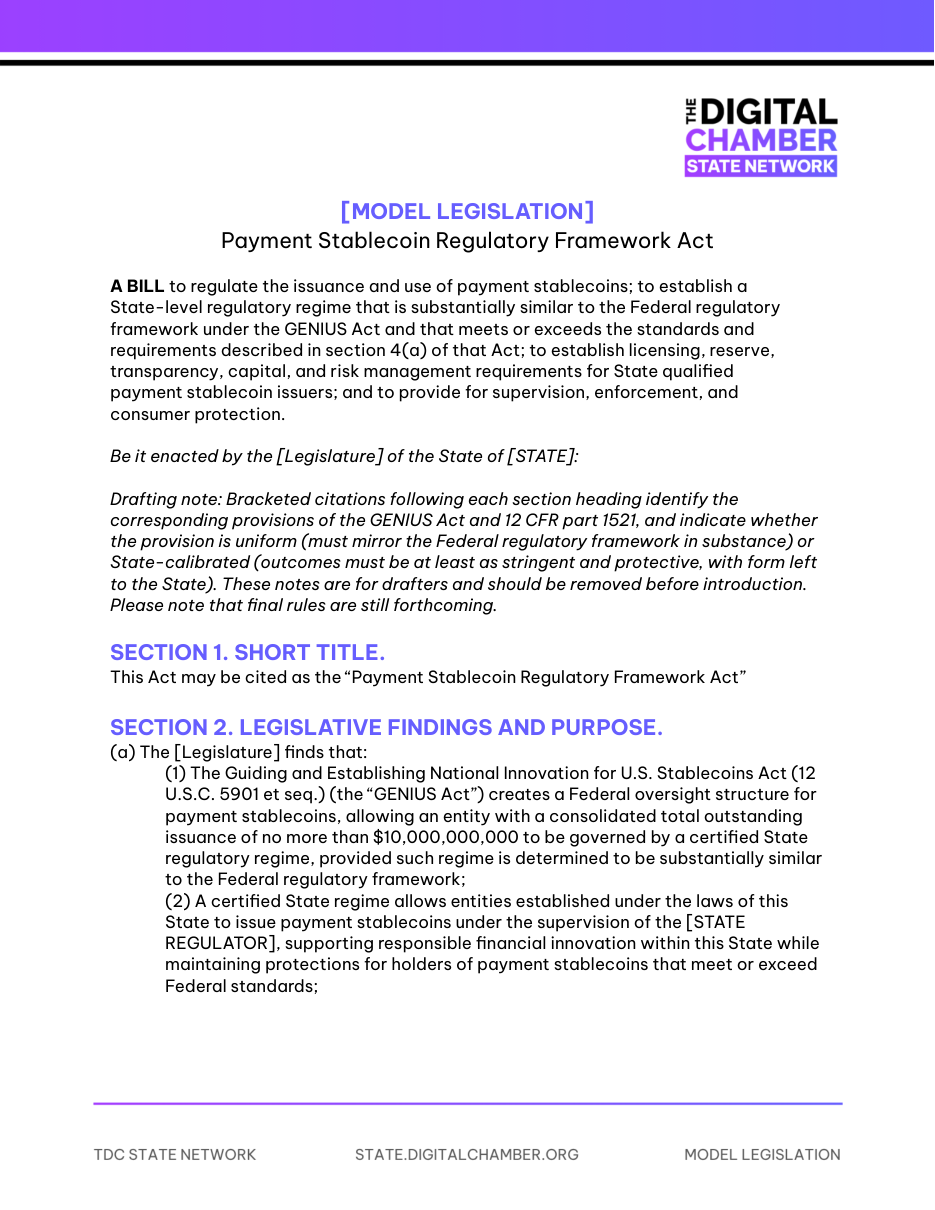 Payment stablecoins
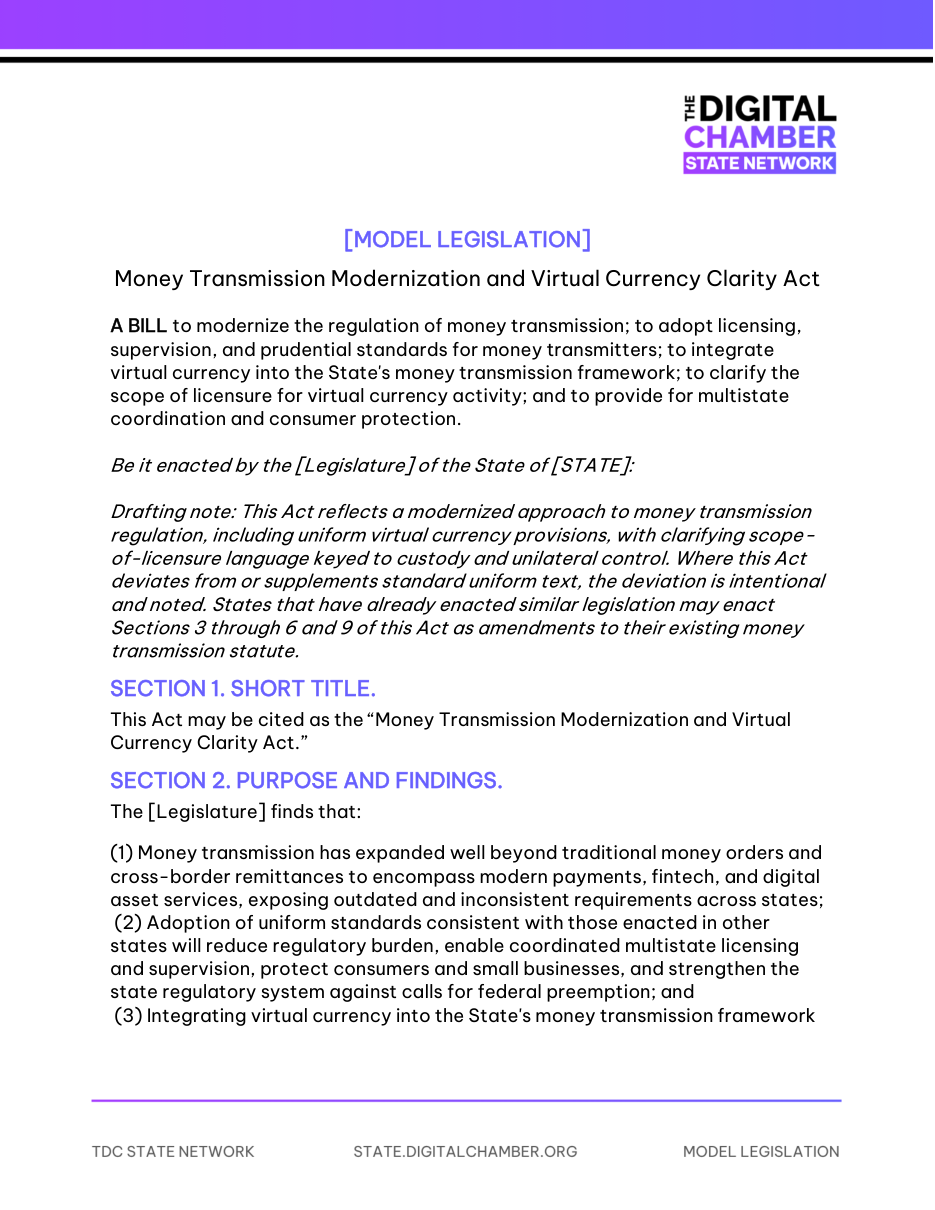 Money transmission
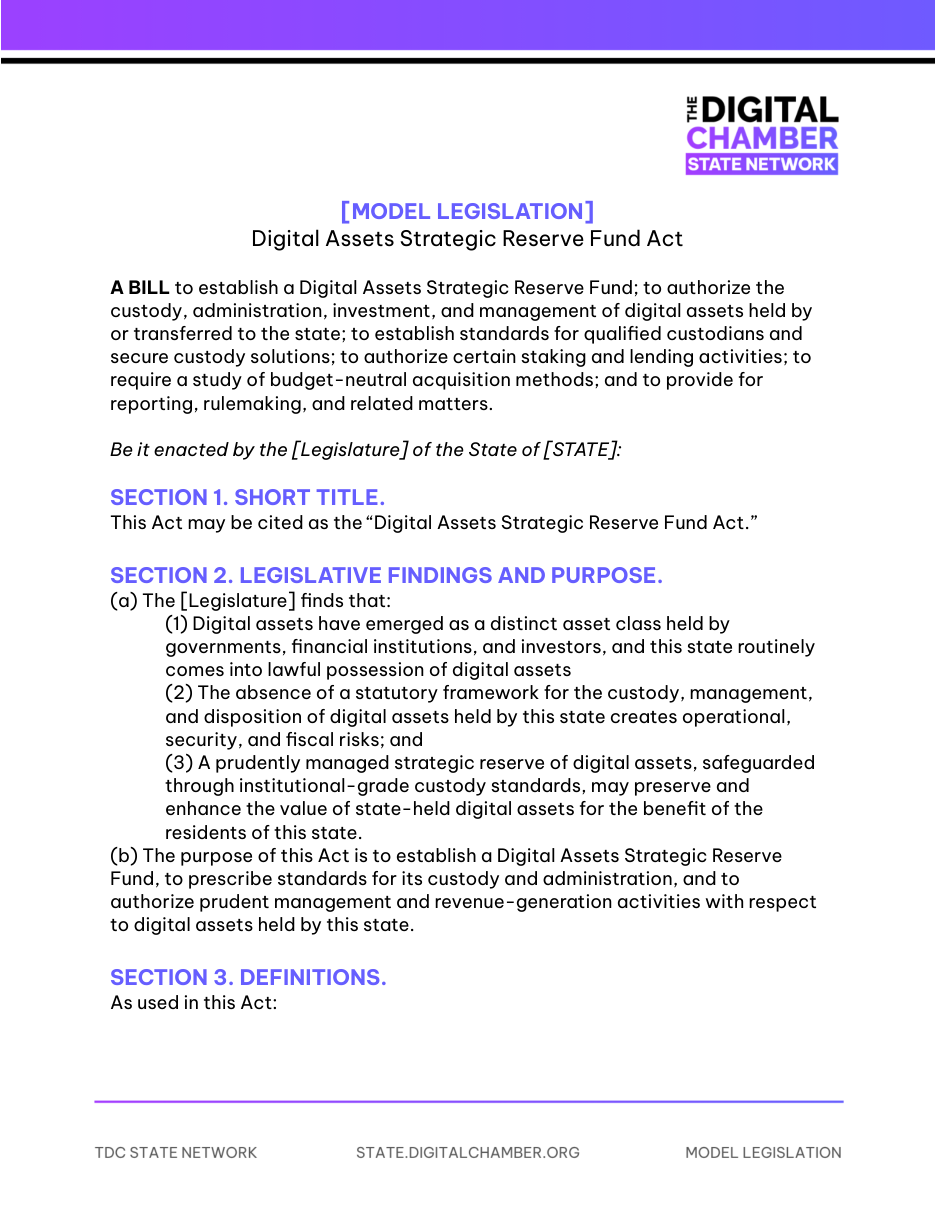 Strategic reserve
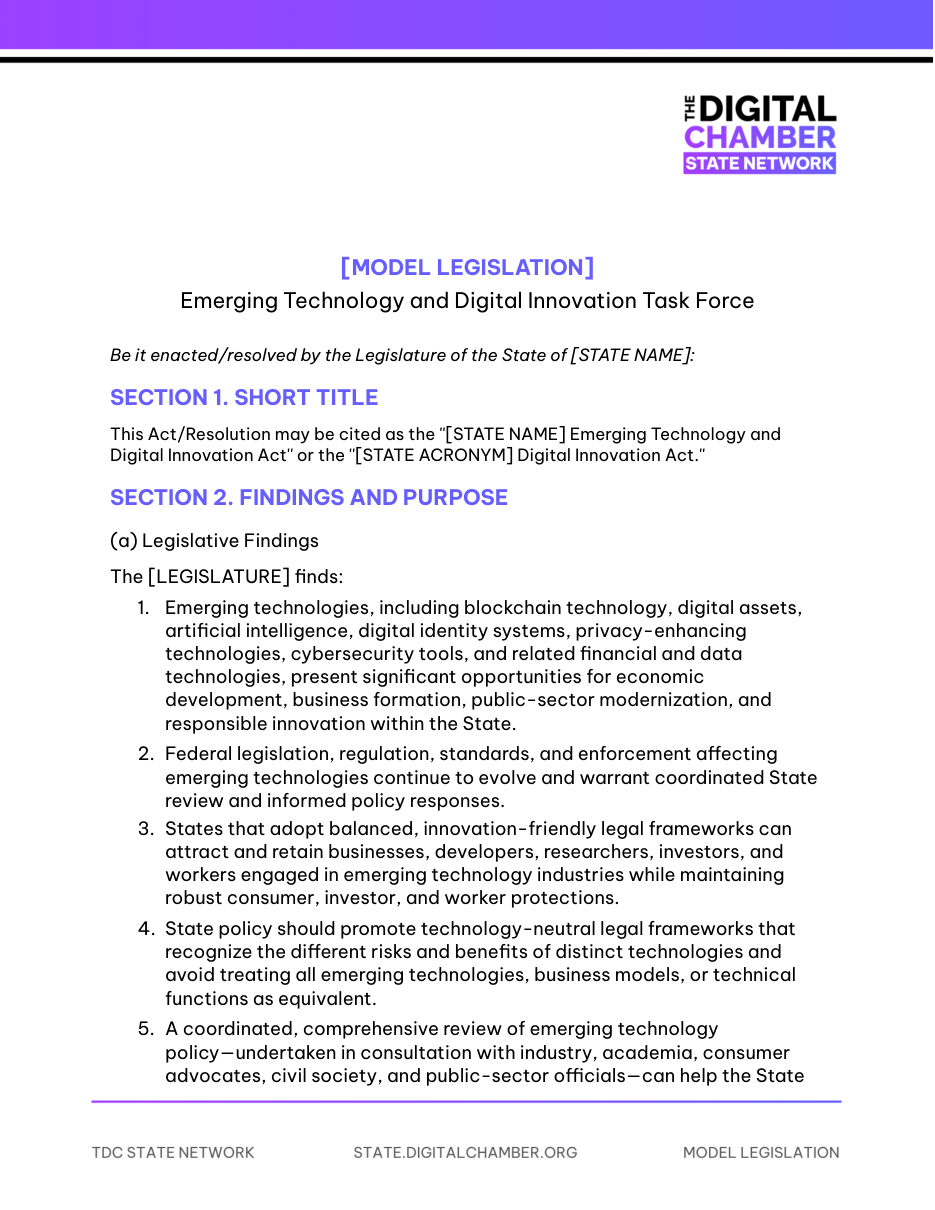 Task force
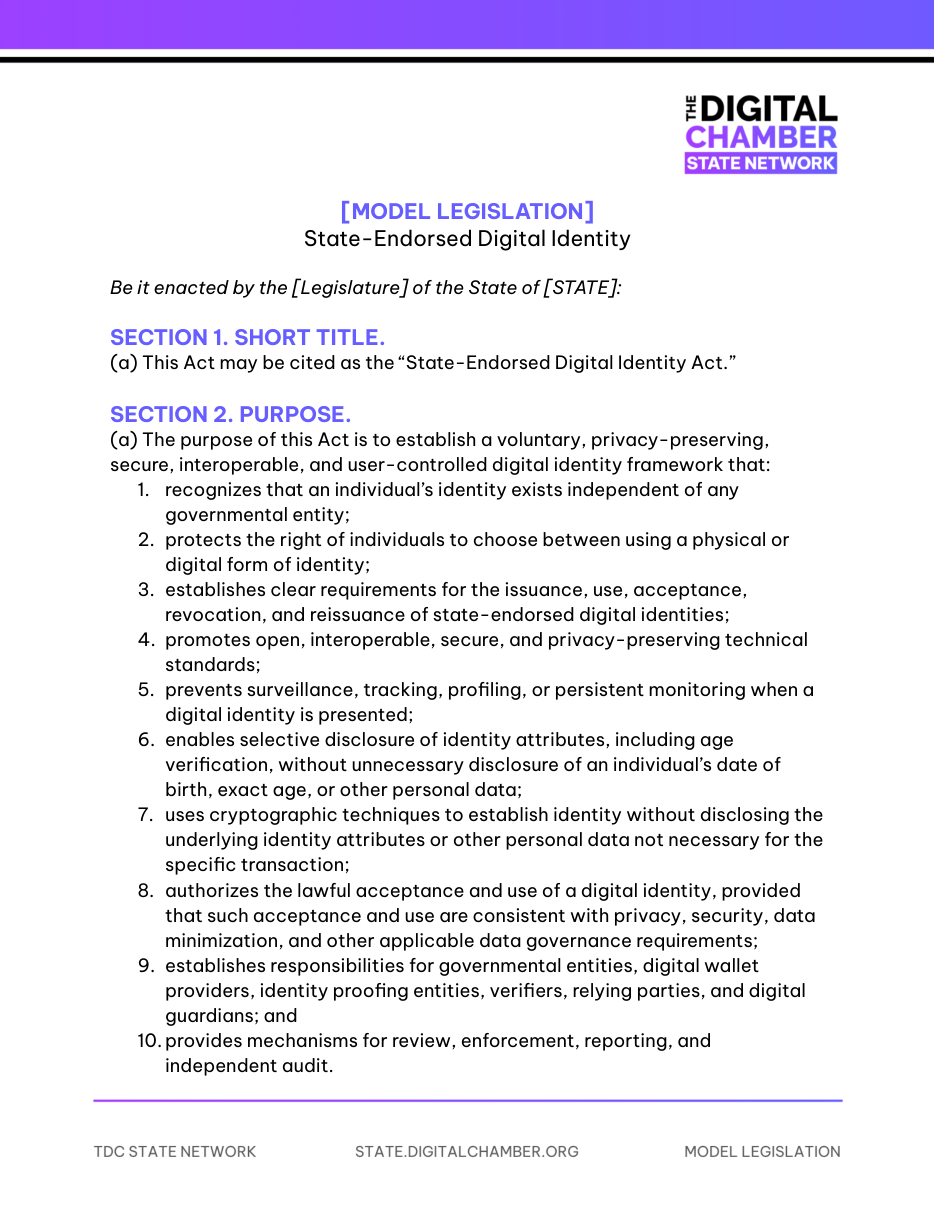 Digital identity
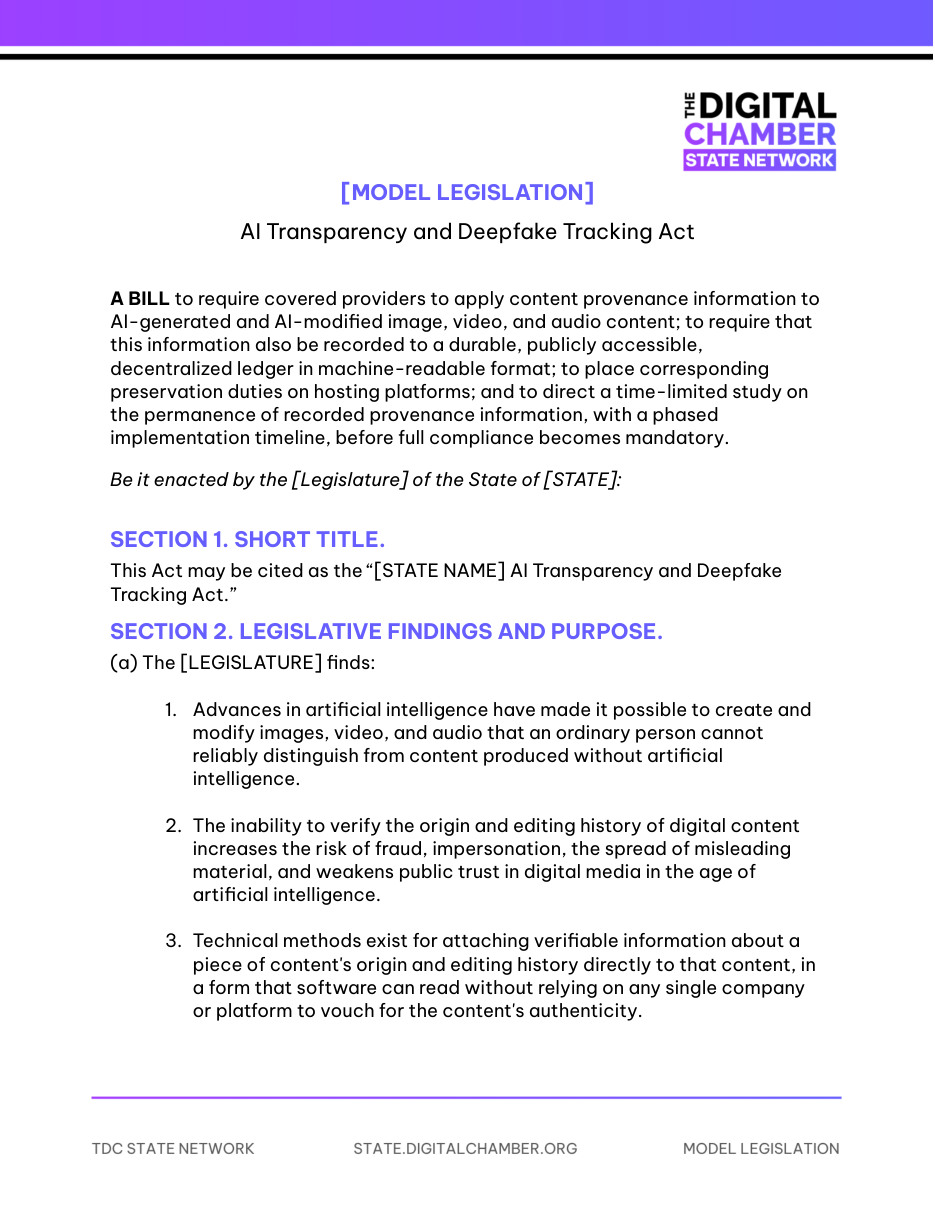 AI content provenance
The six models
Against current Wisconsin law
-
Wisconsin: Gap
Payment stablecoins (GENIUS Act aligned)
A state license for stablecoin issuers with up to $10 billion outstanding, under the federal GENIUS Act’s state pathway: 1:1 reserves, monthly examined reserve reports, redemption rules and no yield.
Wisconsin today. No state stablecoin law. DFI licenses money transmitters under ch. 217.
-
Wisconsin: Partial
Money transmission and virtual currency
Brings virtual currency into money transmitter licensing, limited to firms that hold customers’ assets, and adds protections for those assets.
Wisconsin today. Wisconsin adopted the national Money Transmission Modernization Act (2023 Wis. Act 267, effective 1 January 2025). Virtual currency appears only in the 2026 kiosk law, s. 217.12.
-
Wisconsin: Gap
Digital asset strategic reserve
A state fund holding digital assets the state buys or receives, with custody, staking and reporting rules.
Wisconsin today. No law. The state constitution sends proceeds of forfeited and escheated property to the school fund, and unclaimed virtual currency is converted to dollars before it reaches the state.
-
Wisconsin: Partial
Emerging technology task force
An 18-member temporary task force of legislators, agency heads and outside experts studying blockchain, AI and digital identity together.
Wisconsin today. No statutory task force. The 2026 Legislative Council Study Committee on Cryptocurrency and the Governor’s Task Force on Workforce and Artificial Intelligence (2023) cover parts of it.
-
Wisconsin: Gap
Digital identity
A voluntary state-endorsed digital ID with selective disclosure, age proofs without a birth date, and a ban on tracking.
Wisconsin today. No digital ID law. Drivers must carry the license document (s. 343.18). A 2025 bill to allow electronic license copies did not pass.
-
Wisconsin: Partial
AI content provenance
AI providers embed provenance data in generated images, video and audio and record it to a public ledger; platforms must preserve it.
Wisconsin today. AI labels are required in political ads (s. 11.1303) and synthetic intimate images are a crime (s. 942.09, 2025 Wis. Act 34). No provenance law.
Both sides of each model
- Stablecoins. A certified state regime would let Wisconsin-organized issuers stay home. Holders get 1:1 reserves, monthly examined reports and priority in insolvency.
- Money transmission. Clear lines for wallet software, validators and peer-to-peer users. Customers of custodial firms get like-kind holding and protection from the firm’s creditors, which Wisconsin now applies only at kiosks.
- Reserve fund. Professional management of state-held digital assets, with multi-party key control, public reporting and audit.
- Task force. One forum for licensing and business barriers across technologies, with consumer seats and a public comment period.
- Digital identity. Cheaper, safer onboarding and age checks for businesses. People keep the right to use physical ID, with strict limits on data use and tracking.
- AI content. A network-neutral standard for authentication services. The public gets durable, independent records of what is AI-generated.
Three things to know
- The stablecoin model depends on a federal rule that is not final. TDC notes that no state regime can be certified until the Treasury Department finalizes its comparability rule, and it plans to revise the model.
- Wisconsin’s rulemaking law matters. Wisconsin agencies may enforce only standards that statute or a promulgated rule explicitly allows, and must stop rules with $10 million or more in two-year compliance costs unless the Legislature authorizes them (s. 227.10(2m), s. 227.139). Several models lean on agency rules.
- The reserve model meets the school fund. Wisconsin’s constitution (art. X, s. 2) dedicates forfeiture and escheat proceeds to the school fund, so the model’s main funding sources are already committed.
What happens next
Treasury’s final GENIUS Act rules will shape the stablecoin model. The Legislative Council Study Committee on Cryptocurrency, charged with staking and “other current and potential uses of cryptocurrency,” meets again this fall; its public record is on our 2026 interim committees page. The 2027–28 Legislature begins in January. One commercial-law update that none of the six models covers, UCC Article 12, has its own library entry.
WDBC reports and explains state digital economy policy; this entry is not legal advice. Sources: The Digital Chamber State Network, Model Legislation Library; Wisconsin Statutes chs. 11, 14, 177, 217, 227, 343 and 942, the Wisconsin Constitution and 2025–26 bill histories at docs.legis.wisconsin.gov; 2026 session laws of Florida, Alabama, Georgia, Maryland and Delaware; 12 CFR part 1522. Corrections are welcome at team@wdbc.io.

Analysis like this is what membership funds
Every library entry is researched from the statute books and the bill record, and dated so you know how current it is. Members get the tracker, Intelligence Briefings and early notice when a new entry is published.