
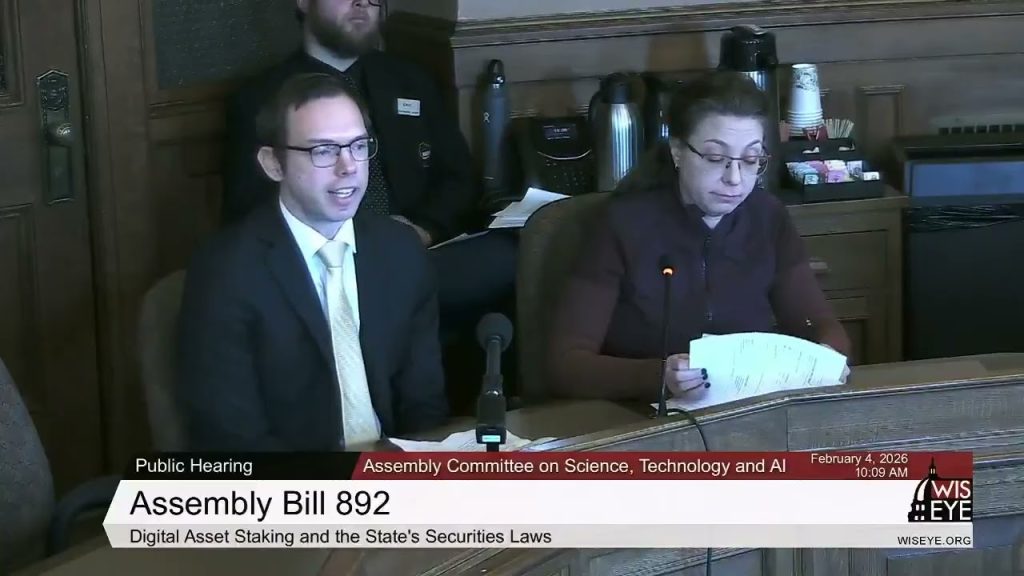
AB 892: the staking hearing
Two hearings, two committee votes, and written opposition from the Department of Financial Institutions: the full record of the Staking Clarity Act.
On 4 February 2026 the Assembly Committee on Science, Technology and AI, chaired by Rep. Nate Gustafson, took testimony on Assembly Bill 892: the Staking Clarity Act. Fifteen days later the bill passed the Assembly. It is the furthest any digital-asset bill has traveled in Wisconsin.
The bill did one thing: put in statute that digital asset staking, and staking as a service, are not the sale of a security under Wisconsin law, and define digital asset, node and staking so the question stops turning on interpretation.
Who testified in support
Rep. Adam Neylon and Sen. Rachael Cabral-Guevara (19th Senate District), the bill’s authors.
Robin Cook, Director of U.S. Policy and Head Legislative Counsel, Coinbase.
Maggie Schmidt, President of the Wisconsin Blockchain Business Council.
Tiara Nicole Williams (T9LET), multidisciplinary artist, founding member of WBBC, and Wisconsin chapter lead for SheFi.
Spencer Smith, founder of AmpliPhi and a director of the council.
Ian McCullough, President of Stand With Crypto Wisconsin, representing over 28,000 advocates in the state.
Kouri Marshall, Senior Director of State & Local Public Policy, Chamber of Progress.
The economic argument
Coinbase’s testimony made the case that staking is infrastructure rather than an investment product: stakers keep ownership and control of their assets, and rewards are paid by the blockchain protocol itself, not by a company. There is no management team deploying capital and no pooled investment.
On the consumer-harm question the company told the committee that in more than six years of offering staking nationwide, no Coinbase customer had lost assets through its staking service, and that a person is statistically more than six times likelier to be struck by lightning than to lose assets to a staking penalty. It also pointed the committee to guidance from the SEC’s Division of Corporation Finance concluding such services are not securities under federal law.
What WBBC told the committee
Our president testified from the creative economy rather than the financial one. She grew up in Mukwonago, works as an artist and community organizer in Milwaukee, and described the income most creatives actually live on: agency work, streaming, ticket revenue, licensing, royalties, modest returns, irregular, seasonal, and widely misunderstood by policy written for salaried workers.
The argument she made was that staking lets people with unpredictable income behave more like responsible businesses, not less: managing cash flow, reserves and runway. And that when platforms geo-block Wisconsin, the effect on a working artist is a statewide blackout on a tool that everyone one state over can use.
She put that against Wisconsin’s brain drain, and against a state that is home to Summerfest and Mile of Music: Michigan, Illinois and Minnesota were moving toward clarity while Wisconsin was not.
Wisconsin companies named in the record
Stand With Crypto’s testimony put four Wisconsin businesses on the record as already building on this technology:
Aeroplicity: blockchain for DoD-compliant traceability in aerospace logistics. Afirmity: blockchain and bioauthentication to verify identity and prevent unauthorized AI deepfakes. WayFi Wireless: blockchain-powered wireless networks delivering internet access. Vessey: food safety and security in Wisconsin dairy.
That list is the answer to the question of who this is for.
The opposition, which came from the state itself
Two organizations opposed the bill. One of them was the Wisconsin Department of Financial Institutions: the agency that regulates this activity.
The two opposed in different ways, and the distinction matters to anyone reading the record afterwards. The Wisconsin Bankers Association appeared at the hearing. DFI did not appear or register; it filed written testimony, submitted by Assistant Deputy Secretary Catherine Haberland. The committee record lists only one appearance against, which is why the agency’s position is easy to miss if you read the proceedings alone.
Department of Financial Institutions
In testimony filed for the 4 February 2026 hearing, DFI opposed AB 892 on the grounds that it “needlessly eliminates Wisconsin investors’ existing legal rights and protections.” Its position was that companies can already offer staking programs in Wisconsin today, provided they register their offerings with the Division of Securities, disclose the risks, refrain from false or misleading statements, and otherwise comply with chapter 551, the same as any other company offering an investment contract to Wisconsin residents.
In other words: not a ban, a registration requirement. Whether that is a workable path or a prohibitive one is precisely the disagreement, and it is the disagreement the 2027 bill has to resolve rather than talk past.
Wisconsin Bankers Association
Lorenzo Cruz, Vice President of Government Relations, testified for the state’s largest financial trade association. WBA’s concern was regulatory consistency: staking can involve monetary transactions, third-party service providers and an expectation of return, and comparable characteristics in traditional markets are regulated. Treating an activity differently because of its technological form, they argued, risks gaps in oversight.
What happened next
AB 892 passed the Assembly on 19 February 2026. The Senate Committee on Utilities, Technology and Tourism recommended concurrence 3–2 on 13 March. The Senate did not take it up before the session closed on 23 March, and the bill died.
The question did not die with it. It now sits with a Legislative Council study committee whose charge is that exact issue, drafting the version that will be introduced in 2027, and three of that committee’s six public members are community bankers or credit union executives.
The Senate heard it too
The companion bill, SB 885, carried the identical relating clause: digital asset staking and the state’s securities laws, and ran on its own track. Sen. Rachael Cabral-Guevara authored it, cosponsored by Reps. Neylon, Gustafson, Knodl, Tranel, Tusler and Wittke, with Rep. Ortiz-Velez added on 10 February 2026, which is what made the staking bills the session’s only digital-asset legislation with authors from both parties.
It was introduced on 27 January 2026 and referred to the Senate Committee on Utilities, Technology and Tourism, which held its public hearing on 25 February 2026: three weeks after the Assembly committee took testimony, and six days after the Assembly passed AB 892.
How the Senate committee voted
On 13 March 2026 the committee took executive action and recommended passage 3 ayes, 2 noes. The bill was made available for scheduling the same day.
It never reached the floor. On 23 March the session adjourned and SB 885 failed to pass under Senate Joint Resolution 1, alongside its Assembly twin.
That is the whole distance between a bill and a law in Wisconsin: two committees, both persuaded, and ten days without floor time.
That hearing was not only about staking: the committee took all three digital-asset bills in one sitting, and the three votes it produced say more than any of them does alone.
The Assembly hearing in full: Committee on Science, Technology and AI, 4 February 2026.
Read it yourself
Hearing testimony and materials, 4 February 2026, all nine statements as filed, including both in opposition.
AB 892 bill text and full history at the Wisconsin Legislature.
SB 885, the Senate companion, text and history.
Staking is fight one of three in 2027
The committee drafting the next version is meeting now. Here is where it stands.