
AB 471 goes before committee
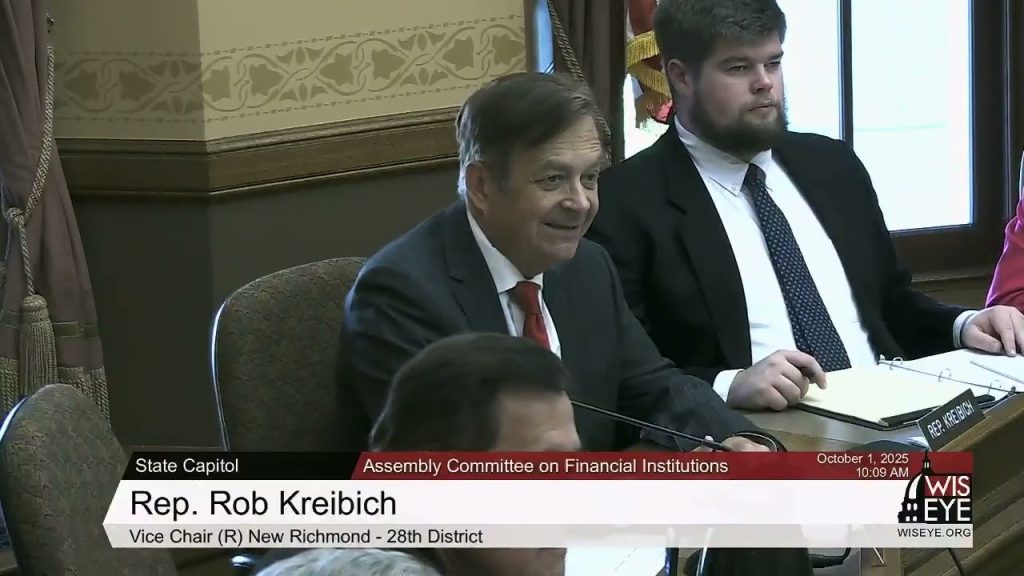
The Crypto Clarity and Innovation Act, Assembly Committee on Financial Institutions, 1 October 2025.
On 1 October 2025 the Assembly Committee on Financial Institutions, chaired by Rep. Duchow, held the public hearing on Assembly Bill 471: the Crypto Clarity and Innovation Act. It was the first time Wisconsin’s Legislature took formal testimony on a comprehensive digital-asset framework.
The Wisconsin Blockchain Business Council testified in support. So did the bill’s author, an artist and entrepreneur from Milwaukee, and the state chapter of Stand With Crypto. Two organizations registered for information only and asked for an amendment. Both of those requests turned out to matter more than the support did.
What the bill would have done
Rep. Adam Neylon (Pewaukee), the author, laid out four things AB 471 did: it defined key terms such as digital asset, self-hosted wallet and node; it established permitted uses with protections from prohibition; it expanded the exceptions to state licensing for administering, developing, mining and staking; and it affirmed the right to self-custody through hardware and self-hosted wallets.
He put the staking problem plainly: Wisconsin is one of only four states (with Maryland, New Jersey and California): that restricts staking. He also made the energy argument, noting Ethereum’s move from proof of work to proof of stake cut its energy use by over 99.9%.
Who testified in support
Rep. Adam Neylon, bill author, with Sen. Patrick Testin carrying the Senate companion.
Tiara Nicole Williams, multidisciplinary artist and technology entrepreneur, co-founder of Craft the Future, a no-code hub.
Ian McCullough, Wisconsin chapter president of Stand With Crypto, representing 23,000 advocates in the state.
Maggie Schmidt, President of the Wisconsin Blockchain Business Council.
What WBBC told the committee
Our president testified as a musician and creative director as much as a strategist, and made the case that staking is not a financial product to be permitted but a form of participation to be protected.
The objections, and why they were right to make them
Two organizations filed for information only, both asking for the same amendment, and both about crypto ATMs rather than about the bill’s purpose.
AARP Wisconsin
Erin Fabrizius, Associate State Director for Advocacy, wrote on behalf of more than 800,000 Wisconsin members. AARP asked the committee to make sure AB 471’s exceptions to the money transmitter law did not exempt crypto-ATM operators from oversight, or preempt the Department of Financial Institutions guidance issued in May 2025 that requires kiosk operators to hold a money transmission license and imposes daily transaction limits.
Their evidence: crypto-related scams accounted for almost 60% of total financial losses in fraud complaints received by the FBI in 2024, and crypto ATMs are used for illicit transactions at double the rate of cryptocurrency overall.
The Badger State Sheriffs’ Association
Filing jointly with the Wisconsin Sheriffs and Deputy Sheriffs Association, together representing all 72 elected county sheriffs and over 1,000 deputies and jail officers: they described kiosks in convenience stores, gas stations and grocery stores charging 10 to 20% or more per transaction, and scams routinely directing elderly victims to use them. Once converted, they wrote, recovery is nearly impossible.
They noted that Iowa, Missouri, North Dakota and Minnesota had already enacted kiosk rules: transaction limits, consumer warnings, refund policies, registration.
What happened next
AB 471 never reached a floor vote. An Assembly amendment was offered on 31 October 2025, and the bill died in committee when the session closed on 23 March 2026.
The consumer-protection concerns did not die with it. The Legislature took the kiosk question up separately and passed it as 2025 Wisconsin Act 226, enacted 8 April 2026, with licensing, a $1,000 per-customer daily cap, fraud warnings, photo ID and a 30-day refund window.
That sequence is the useful lesson, and it is why we say it out loud rather than quietly: the coalition that asked for an amendment got their statute, and the framework bill got nothing. A digital-asset framework that arrives without its consumer protections already built in does not pass in Wisconsin. In 2027 we intend to bring both together.
The full public hearing on AB 471, 1 October 2025.
Read it yourself
Hearing testimony and materials, 1 October 2025, every statement quoted above, as filed.
AB 471 bill text and full history at the Wisconsin Legislature.
Where this goes in 2027
Digital assets is one of three fights on our agenda, and the committee drafting the next version is already meeting.